PULSE Survivors' 10 Unanswered Questions, Ten Years Later

Updated: May 17
On June 12, 2026, it will have been ten years since 49 people were murdered at the PULSE nightclub in Orlando, Florida. The City of Orlando has spent millions of dollars acquiring the property, commissioning designers, and planning a $12.5 million memorial it insists will provide survivors and families with "closure."
It will not.
Because closure does not come from a ribbon cutting. It does not come from a visitor center, a 4.9k run, or a rainbow-washed memorial. Closure — to whatever extent it is even possible — can only come from the truth. And the City of Orlando has spent ten years making sure we do not get it.
Meet Jorshua
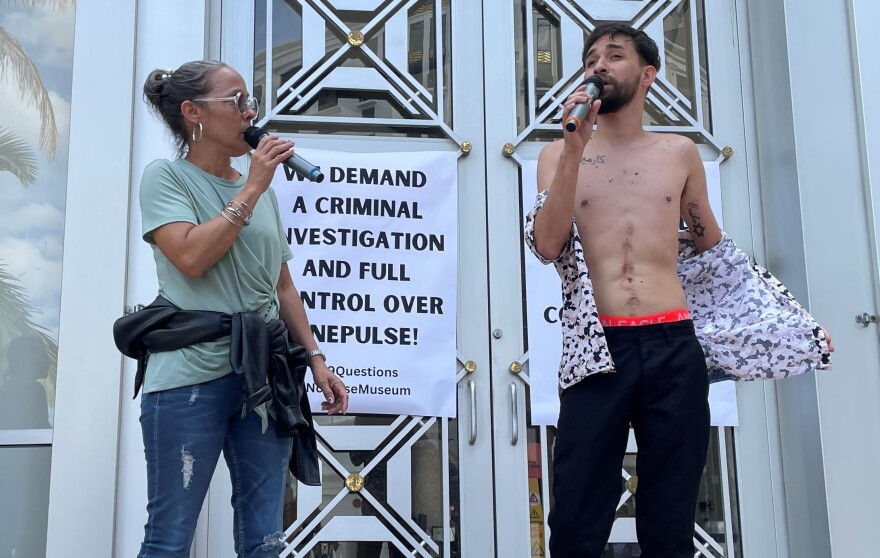
Jorshua Hernandez Carrion was inside PULSE on June 12, 2016. He was shot multiple times — once in his left arm and once in his torso. He was trapped in the south bathroom for nearly three hours, unable to escape. From his standpoint, furniture and stripper stages blocked what could have been an exit through the double doors. The bathrooms were the only place left to run.
He still has a bullet fragment lodged in his body.
Ten years later, Jorshua is not asking for the City's memorial. He is asking for answers. Basic, direct, factual answers to questions the City of Orlando has the information to answer — and has chosen, repeatedly, not to.
On April 1, 2026, Jorshua sent an email to Heather Fagan, the City's Chief of Staff for the Office of the Mayor Buddy Dyer who handled its media responses in the aftermath of the shooting, with the subject line: "You Owe Us the Truth About Pulse."
He was direct:
"So I need to ask you plainly: why did you tell the media there were no blocked exits? That there was no evidence of the nightclub being overcrowded? Why did you use language to purposely mislead them into thinking there were no violations or issues at the club?"
He reminded her that Luis Omar Ocasio Capo's family only learned — years later — that an exit was blocked the night their son was murdered. That they learned it not from the City, but from a survivor who was trapped with him. That the City had the photographs. That the City chose not to release them for nine years.
"You helped keep it from them," he wrote.

Ms. Fagan responded with more lies and fluff.
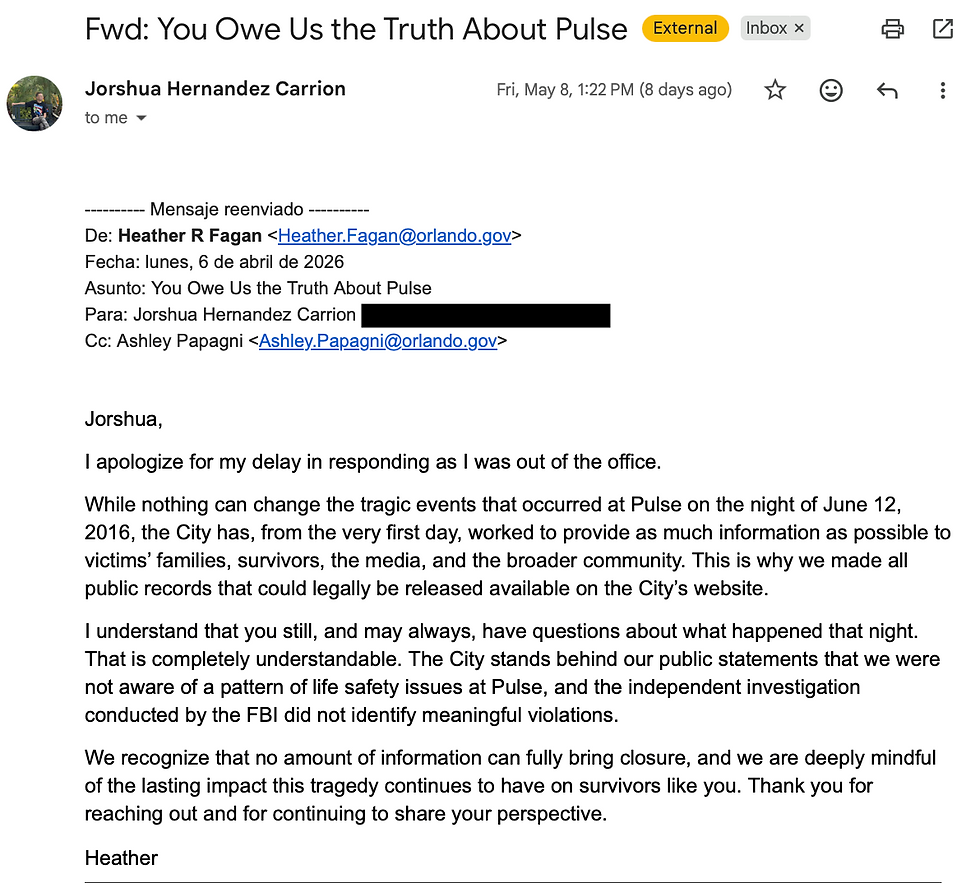
Jorshua responded, confronting those lies head-on.

Fagan again resorted to dismissive banter and carefully managed public relations language instead of directly confronting the documented evidence and unanswered questions.

The Questions the City Won't Answer
On April 6, 2026, Jorshua sent a follow-up email directly to Mayor Buddy Dyer, Commissioner Patty Sheehan, Heather Fagan, and Ashley Papagni, with the subject line: "10 Questions the Office of the Mayor Must Answer to Finally End 10 Years of Silence About PULSE."

Two days later, after no responses to either email, victim advocate Zachary Blair forwarded Jorshua's emails to the entire City Council for answers, as well as to Orange County's elected officials who are providing the City of Orlando with $5M in taxpayer-funded grant money to fund the City's proposed memorial.

The questions fall into several categories, each one a window into a specific dimension of the City's failures. You can read the full list of questions posed to the City of Orlando here:
That file was also sent to the City.
These are not abstract policy questions. Rather, they are very specific and pointed. They are also questions only the City of Orlando can answer and are about PULSE's code violations, unpermitted renovations, the OPD's failure to follow active shooter protocol, and other actions the City took after the shooting.
This Has Happened Before
This is not the first time these questions have been raised, and the City knows it.
In 2020, survivors, family members, and PULSE-affected community members raised many of these same questions at a public City Council meeting through the Community Coalition Against a Pulse Museum. We were ignored.
In 2022, similar questions were asked via email. City Attorney Mayanne Downs responded by instructing City employees to delete emails and made clear the City had no intention of responding. This was so brazen it was covered by The Nation magazine.
Now, in 2026 — ten years after the massacre — Jorshua is being ignored again.
These questions have not gone away. They will not go away. They will follow this City until they are answered.
What the City Could Actually Do
The City has spent millions of dollars on a memorial premised on the idea that it will help survivors heal. But the one thing the City could actually do to help survivors find some measure of peace costs nothing.
Answering PULSE survivors' questions is free.
Survivors cannot "move on" from what the City has never accounted for.


Comments